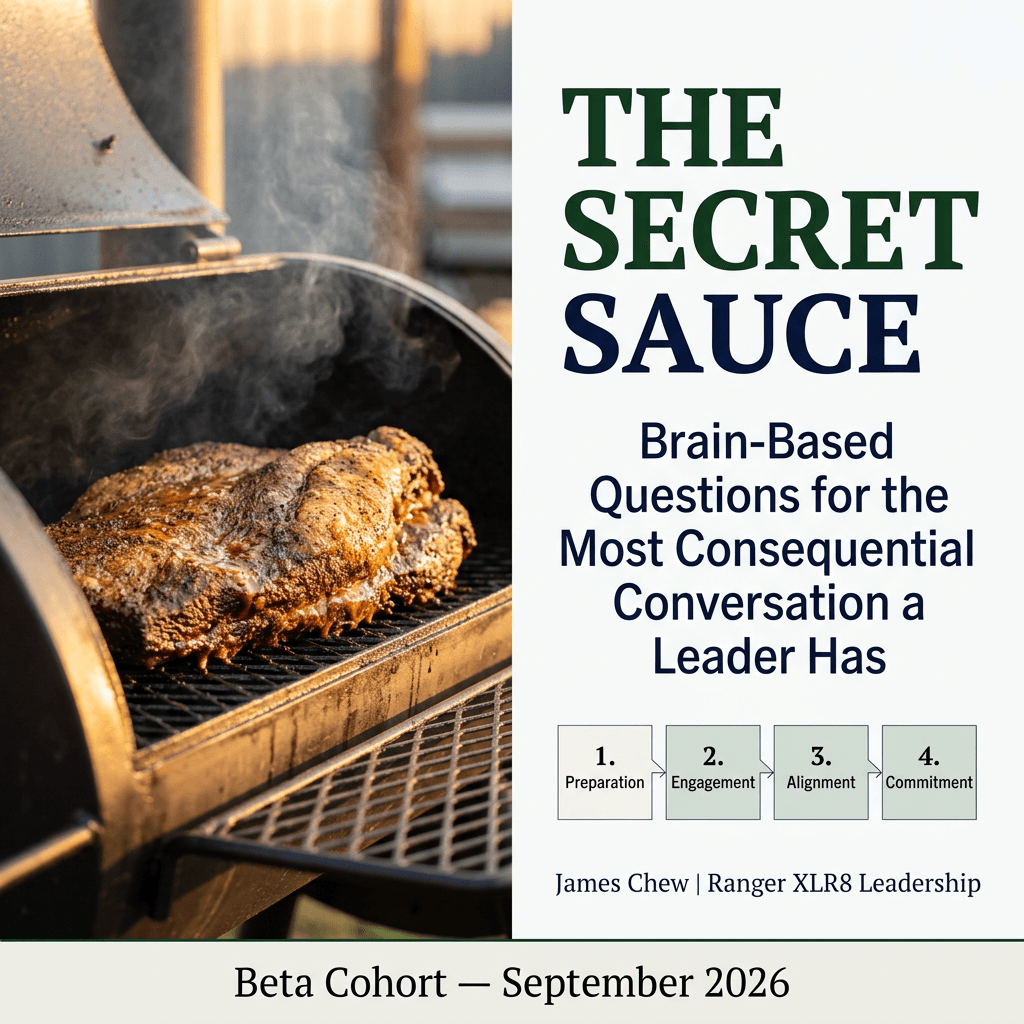
Last weekend I was at a backyard BBQ watching a friend ruina brisket.
He kept opening the lid. Every 10 minutes. "Just checking."
Every time he opened it, the heat escaped, the smoke escaped, and the bark never formed. I told him: stop opening the lid. The brisket is doing its job. Trust the process.
He didn't listen. The brisket came out tough.
I thought about it on the drive home, because I think aboutfeedback for a living.
The way most senior leaders give feedback is exactly thesame as my friend cooking that brisket.
They keep "opening the lid." They keep checkingin. They keep restating the point. They keep pushing for the verdict to land.
And every time they do, the heat — the trust, the engagement, the willingness
of the other person to actually hear the message — escapes.
The other person nods. They agree. They walk out of theconversation. And the behavior doesn't change.
I've watched this happen in boardrooms of $15M operatingcompanies. I've watched it happen in global manufacturing operations across multiple countries and generations. I've watched it happen in the U.S. Army —at the 75th Ranger Regiment
The fix is not "be more direct." That is theversion of honesty that masquerades as courage. It lands on the other person like a verdict. Biologically, their amygdala hijacks their prefrontal cortex.
They cannot hear you. They are surviving.
The fix is in what you ASK, not what you SAY.
I've spent the last decade turning that insight into afour-phase framework for giving feedback that actually lands:
Phase 1 — Preparation (Permission, Purpose, Process,Payoff). The 60-second brief at the start of the conversation that lowers the threat and hands the listener a map of what's coming.
Phase 2 — Engagement (Participation, ProblemAwareness, Solution Awareness). The leader talks 30%. The listener talks 70%. When the listener names the problem in their own words, they can solve it. When you name it for them, they will resist it.
Phase 3 — Alignment (Problem Solve). Restate, add,test, problem-solve. The most underused move in leadership is the restate.
Phase 4 — Commitment (Lock the next move). What, who,when, check-back. The check-back is the part most leaders skip, and it is the part that determines whether the commitment holds.
It is neuroscience-grounded, battle-tested in the 75thRanger Regiment, refined in real operating companies, and now the spine of a course I'm calling Breaking Through Feedback Avoidance: The Secret Sauce.
The title is not a metaphor. The secret sauce in givingfeedback that lands IS the question. The recipe is in the book.
This fall, I'm opening a beta cohort of the livecourse. 10 seats. 4 weeks. Live group sessions on Thursdays at 1 PM CDT. 75% off at $4477 per seat.